 Gearfuse Technology, Science, Culture & More
Video games are a central element of modern life for youths, teens, and adults, as well. Whether we are a casual cell player, a serious eSports player, or somebody who barely touches a controller, the topic of video gaming tends to bring about a zeal of opinions. Here, we’re going to explore both sides of video games, laying bare their benefits and drawbacks. The purpose isn’t to condemn nor glorify them, but instead provide a better sense of trade-offs and enable you to make better decisions about whether (and how) to indulge.
The Pros of Video Games
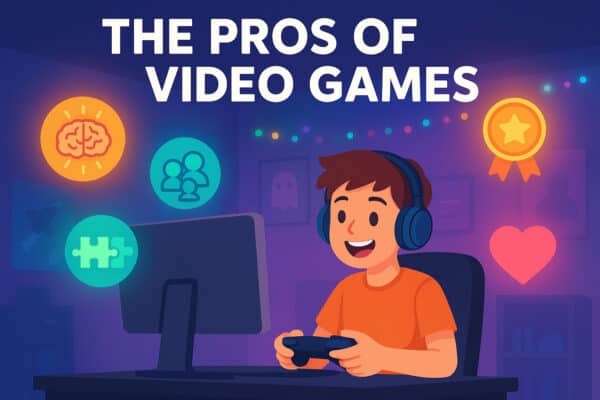
1. Boosted Cognitive Function & Brain Plasticity
Among the most frequently mentioned advantages of debates regarding pros and cons of video games are their ability to stimulate intellectual skills. A number of studies suggest gamers are inclined to develop better skills in:
- Attention and multitasking — Fast games require gamers to attend to shifting visual and auditory information. It might expand focus span and ability to multitask.
- Problem-solving and strategy thinking — Games like puzzles, resource management, and decision patterns require gamers to think ahead, adapt, and plan ahead.
- Memory and spatial ability — Exploring virtual worlds, memorizing maps or enemy locations, and memorizing mechanics build working memory and spatial sense.
Moreover, Cleveland Clinic notes some of these types of games have a potential of creating gray matter, a brain part linked to memory and interconnectivity. Therefore, games are not just recreation, they are mind exercises if dealt wisely.
2. Improved Hand-Eye Coordination & Reaction Speed
Action, shooting, sports, or rhythm games hone fine motor skills, reflexes, and coordination. In everyday life, they can apply to quicker reaction times and improved management for activities requiring hand and eye coordination.
For example, surgeons, pilots, or experts who operate in high-precision fields can use simulation games or virtual reality to learn under stress.
3. Social Connection, Teamwork, & Community
As contrasted with stereotypical loner gamer, contemporary games are highly social activities. Internet communities, co-operation modes, guilds, and multi-player enable gamers to:
- Cooperate to achieve shared objectives
- Real-time communication (voice/text
- Form relationships beyond geographical frontiers
These social factors can educate teamwork, negotiation, leadership, and online communication skills.
To many, especially those who live far off or even serve communities, online gaming communities become critical points of connection.
30 Best ROM Sites in 2025 – 100% Safe ROM Alternatives for Downloading Roms
4. Emotional & Psychological Benefits
Video games also fulfill positive emotional purposes:
Stress relief and escape — Immersive experiences provide people with a short-term release from everyday stressors.
Sense of accomplishment — Overcoming levels, quests, or challenges potentially would boost motivation and confidence.
Creative expression — World-building games (e.g., Minecraft) or sandbox games allow release of designing, thinking, and creating.
Learning through failure — Games usually entice retry, adaptation, and incrementally guided learning, which helps to foster resilience.
However, advantages accrue more consistently when gaming is a judicious and moderate activity and less of an escapist habit.
5. Therapeutic Uses & Rehabilitation
In addition to entertainment, video games are also employed for therapeutic and clinical purposes:
- Additional research also shows that gaming can distract patients during chemotherapy, relieving nausea and anxiety.
- In physiotherapy or occupational therapy, specific games may aid recovery in patients having motor dysfunction.
- With other developmental disabilities (e.g., autism, attention disorders), games are useful for establishing socialization and cognitive development skills.
Thus, advantages and disadvantages of playing video games potentially spread to health and clinical areas as well.
Four Bathroom Design Secrets to Perfect Your Next Home Renovation
The Cons of Video Games
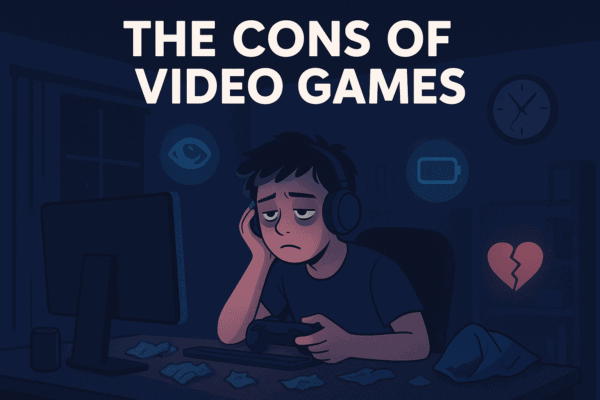
True, of course, there are no rewards for free. As with many technologies, risk accompanies reward. Listed below are the more severe negatives when gaming is abused or imbalanced.
1. Addiction, Overuse, & Escapism
Among the best contested pros and cons of video games are gaming addiction, also known as “gaming disorder.” WHO classifies gaming disorder as a behavioral health condition.
Signs are:
- Inability to control playing (playing for a longer period of time)
- Neglect of other life aspects (school, relationships, health)
- Withdrawal symptoms if unable to play
Since games are constructed around reward loops, progression systems, or microtransactions, games are inherently compulsive. Once addiction sets in, it often tips the balance against almost all of the advantages of gaming.
2. Negative Health Effects (Physical & Cognitive)
Long-playing games, particularly successive games, lead to:
Eye strain, headache, screen fatigue – Excessive screen use contributes to eye disorders.
Musculoskeletal disorders – Bad posture, repetitive strain disorders (RSI), back and wrist discomfort.
Sleep disturbance – Late playing and exposure to blue light may disrupt sleep quality.
Leisure-time sitting/obesity – With games dominating leisure activities, exercise falls by the wayside.
Overeating – Online games also lead to binge eating, sometimes.
In rare cases, some games are reported to induce seizures among predisposed individuals.
3. Exposure to Violence, Aggression & Desensitization
Perhaps one of the most debated of all points noted under both advantages and disadvantages of playing video games is whether aggressive games cause aggression. Several studies have suggested a connection between exposure to aggressive content and elevated aggression among individuals.
However, it remains debatable whether the effect is a priori causal, or whether predispositions, social environment, or character mediate.
Also:
- Exposure to violent or explicit content on a regular basis may desensitize gamers to violence eventually.
- Certain games obscure the distinction between realistic violence and a game, confusing children between what is real and what is not.
It’s not that games are violent, it’s that it’s really important for parents and gamers, young gamers, to be picky.
4. Impaired Real-Life Relationships & Neglect of Responsibilities
If gaming is excessive, many real-life activities are likely to suffer:
- Academic work or work productivity may diminish
- Interactions with family and other friends could worsen
- Simple activities/hygiene/religious rituals or physical environment (e.g., work, chores) may
- Mental health issues, for instance, may be ignored
As some critics note, games can serve as an escape from real challenges, but overreliance may lead to avoidance of real responsibilities which worsens life quality.
5. Hidden Costs & Monetization Practices
Modern games also typically include microtransactions, lootBoxes, season passes, and “pay-to-win” aspects.
These features can:
- Promote reckless expenditure, particularly among youth gamers
- Incorporate gambling‐like reward systems into game mechanics
- Steer game development towards income generation instead of player enjoyment
Critics say monetization can manipulate psychological biases and convert joy into money stress.
6. Cognitive & Attention Concerns
There’s some emerging evidence that excessive gaming may:
- Lead to short attention span or distractibility
- Have real-world applications, specifically in work life or school work
- Strengthen instant gratification, diminishing slow, effortful activities less desirable
Even if it’s not definitive, what’s problematic here is that excessive dependence on ultra-arousing games might interfere with sustained attention to offline activities.
Dislyte and Mythology’s Major Influence on Modern Gaming
Balancing the Pros and Cons of Video Games
Because both benefits and detriments of video games overlap, how, when, and why an individual game determines heavily if benefits end up being their outcome. The following are some real-world methods for tilting the equation towards benefits:
1. Set Clear Limits & Schedules
- Assign a highest possible daily/weekly gaming hours
- Use alarms or “screen time” modes to force breaks
- Do your gaming until absolutely necessary work (work, studying, chores)
2. Choose Games Mindfully
- Select games with pedagogy, storytelling, or co-op functionality
- Steer clear of/limit times spent on titles aggressively monetizing
- Choose less-violent games and games having nice communities for child gamers
3. Breaks & Physical Movement
- Adhere to the 20-20-20 rule: Every 20 minutes, for 20 seconds, view things 20 feet away
- Get up, stretch, walk between sessions
- Add exergames or motion games to your routine for exercise
4. Combine Offline Social Time
Do not make online relationships your only social outlet. Offset it by scheduling in-person events, real-world clubs, or hobbies.
5. Be Aware of Warning Signs
Be careful for:
- More playtime
- Sleep, relationship, or mood decline
- Emotional suffering when game access is withheld
- Shirking responsibility
In case symptoms emerge, it might become necessary to revisit patterns, or to request a specialist’s intervention.
6. Use Games Positively
- Implement games as a learning process (history, language, strategy)
- Co-play with family or friends to foster connection
- Apply therapeutic games under supervision if necessary
Final Thoughts: Are Video Games “Good” or “Bad”?
The advantages/disadvantages of video games cannot be simplified into a yes/no. On their best days, video games polish cognitive ability, build social connection, and give a lift to emotions. On their worst days, they instill addiction, damage health, destroy relationships, and strip finances.
If there’s a single takeaway, it’s this:
Moderation, intention, and self-awareness matter more than the games themselves.
With proper thought, video games are a powerful tool — but, like all tools, capable of causing harm if poorly used.