 Gearfuse Technology, Science, Culture & More
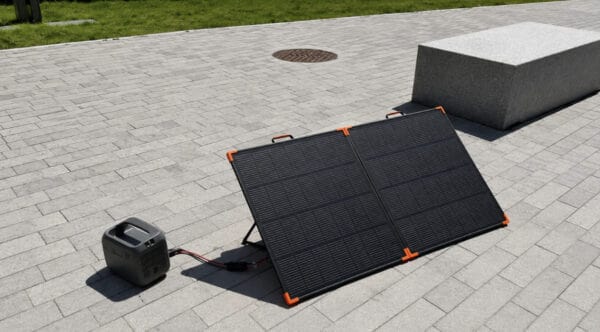
Portable power stations are a convenient device for those who want to operate off the grid. A battery can power essential devices at a camp, on an RV adventure or as a backup power supply at home for a weekend camping trip or backup power. However, when the stored energy is used, the next question becomes easy to answer: how to recharge it?
Solar power for mobile use comes in handy in that case. A portable power station can be recharged with the sun’s energy from a solar panel, which is compatible with the station. Foldable designs are especially useful for anyone who requires an energy source that can go with them.
Why Portable Solar Power Matters Off the Grid
The whole concept of off-grid power is balancing the generation, storage, and usage of electricity.
A portable power station can store electricity; however, it has a limited capacity. As lights, phones, laptops, cameras, refrigerators, or other equipment are used, the available charge is depleted over time. A solar panel provides a way to put energy back into the battery when sunlight is available.
Solar is beneficial in areas where electricity supplies are scarce. Campers will be able to charge their electronics throughout the day, RV users will be able to charge their electronics if they are not plugged in, and homes will have an extra charging solution if they have a power outage.
The key is to think of solar as an entire power system and not just an alternative to the battery.
The Problem With Traditional Portable Solar Setups
Compact solar power has always been a trade-off between power and convenience.
The more solar energy that can be captured, the bigger the solar array, but carrying and storing a large rigid solar array may not be feasible for someone who is travelling in an RV or packing equipment in a car. The smaller panels are lighter to carry, but may offer less power.
The idea behind foldable panels is a different one. The various panel sections can be arranged together to offer a bigger collection area when working and folded down when it is time to move or store them.
This is especially true of the portable power-station market, where users require more and more equipment to be able to transport from their home to a campsite, their vehicle to an emergency, and so on.
What Makes Bifacial Solar Panels Interesting?
One to keep an eye on is bifacial solar technology.
Traditional solar cells mainly harness sunlight via the front. A bifacial panel is a panel that is optimised to collect light on both sides. The back can utilize reflected or diffused light sources from the surroundings.
The net advantage is dependent on circumstances. There are reflective surfaces, over which one could place a panel, that have more useful light on the back than those whose ground is dark or absorbent. The result can be influenced by the panel height, orientation, weather, and surface, etc.
This doesn’t necessarily mean that a bifacial panel will generate a set percentage more energy in every scenario. Rather, it provides the panel with a chance to collect light when it’s available.
The flexibility it might provide portable users who can move a panel to where they want it and how they want it to be displayed could come in handy.
Where the ZOUPW 430W Foldable Panel Fits
This is the category where ZOUPW’s portable solar offering becomes relevant. The company focuses on portable power and solar solutions designed for applications where conventional fixed installations are not always practical.
The ZOUPW 430W Bifacial Foldable Solar Panel takes the higher-output portable-panel approach, combining a foldable design with bifacial solar technology. The product page identifies the panel as using N-Type 16BB solar cells and positions it for portable solar-power applications.
For someone building a solar charging setup around a compatible portable power station, the attraction is straightforward: a higher-rated portable panel can provide substantial charging potential while still being designed to fold for transportation.
However, the 430W figure should be understood as a rated power figure, not a guarantee of constant real-world output. Solar production changes throughout the day according to sunlight and operating conditions.
The ZOUPW 430W Bifacial Foldable Solar Panel is designed for portable solar-power applications where flexibility and easy transportation are important. Its foldable design makes it suitable for use with compatible portable power stations, providing a convenient solar charging option for outdoor activities, travel, and off-grid power needs.
How Much Energy Can a Portable Solar Panel Produce?
There’s one of the easiest errors that you can make when purchasing solar equipment, and that is that you get the two terms mixed up.
Power is measured in watts, and energy stored or consumed over time is typically measured in watt-hours. The peak rated wattage of a solar panel represents the power produced under certain testing conditions. Actual production will vary.
300 watts of energy would be supplied to a power station by a hypothetical panel operating steadily for one hour, for instance. In practice, the light from the Sun is not quite uniform, making the computation somewhat more complex.
The amount of energy reaching the battery can vary due to cloud cover or shadows, orientation of the panels, temperature, position of the sun and charging system efficiency.
Hence, it is better to size the energy station and its daily energy needs around the solar setup, and not the headline wattage of the solar panel.
Morning, Noon, or Afternoon: When Is Solar Charging Best?
The charging rate from sunrise to sunset from solar panels is not a perfectly linear process.
In the morning, the sun’s intensity is usually increasing as the sun rises. The sun is usually higher in the sky around midday, potentially offering higher solar irradiance. This is usually followed by a decline in output in the later afternoon due to the sun’s angle.
This varies with location, season, weather, and the direction of orientation of the panel.
This affords campers and RV users a practical opportunity: to set up the panel as early as possible in the day to maximise the amount of daylight, and orient the panel to catch as much direct sunlight as possible. If the site can be moved about, it may be possible to position the panel throughout the day to obtain a more favourable angle.
It’s not just the hours of daylight that are being counted. It’s to utilise sunlight as best as possible during these hours.
Portable Solar for Camping and RV Travel
One of the most apparent applications for foldable solar panels is camping.
A mobile solar system can lower the need for electrical hookups at camp sites, and offer an alternative and renewable power source for compatible battery systems. A user can charge a power station at the central level in the daytime, and draw power from it during night hours either by installing multiple power stations or by stacking them.A user can charge a central power station during the day and draw power from it at night, either by installing multiple power stations or by stacking them.
The same can be translated to a larger scale in RV’s. When parked, a solar system can be used to complement the vehicle’s electrical system and thus support the vehicle’s electrical devices and appliances within the limits of the electrical power station to which the solar system is connected and the overall setup.
Planning is the key. Users should also be sure to verify the maximum solar-input power, connector requirements, maximum solar-input current and voltage of the power station before buying a panel. A panel and power station need to be electrically compatible; simply having matching-looking connectors is not enough.
What to Consider Before Buying a Foldable Solar Panel
The highest wattage is not necessarily the best choice for every user.
Portability should be considered alongside output. Think about where the panel will be stored, how far it needs to be carried, and how frequently it will be deployed.
It is also worth considering:
- Power requirements: How much energy does the connected battery actually need?
- Compatibility: Does the panel match the power station’s solar-input specifications?
- Setup: Can one person position and pack it away comfortably?
- Weather exposure: Will the equipment regularly be used outdoors?
- Sunlight: Is there enough unobstructed daylight at the locations where it will be used?
- Storage: Does the folded size fit comfortably in your vehicle or camping setup?
For buyers researching portable solar equipment, ZOUPW provides a useful starting point for exploring the company’s solar and portable-power products.
The Bigger Picture: Building a Flexible Energy System
The appeal of portable solar is ultimately about flexibility.
A battery gives you stored energy. A solar panel gives you a way to replenish that energy when conditions allow. A foldable design makes it easier to take that generation capability with you.
For outdoor enthusiasts, this can mean fewer restrictions on where electronic equipment can be used. For RV travellers, it can add another charging option away from hookups. For emergency preparedness, it can provide an additional way to maintain access to stored electrical power.
The ZOUPW 430W Bifacial Foldable Solar Panel is aimed at users looking for a higher-output portable solar option with a foldable format and bifacial design.
Ultimately, the best portable solar system is not simply the one with the biggest number on its specification sheet. It is the one whose panel, battery, charging input, portability, and expected use all work together.
As portable power continues to become a bigger part of the outdoor technology market, foldable solar panels offer an increasingly practical bridge between modern battery-powered gadgets and the renewable energy available above us every day.