 Gearfuse Technology, Science, Culture & More
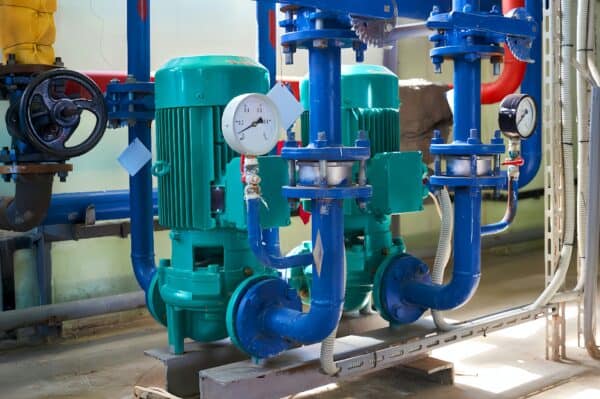
When people think about the machines behind modern life, they picture the flashy stuff. Server racks humming in data centers. Robotic arms welding car frames. The chip fab clean room.
Most of those environments would grind to a halt within minutes if a single, unglamorous piece of equipment stopped spinning: the pump.
Pumps move the coolant through your GPU’s liquid loop, the ultra-pure water through semiconductor fabs, the fuel through the rocket on the pad, and the chemicals through the plant that made your phone’s battery. They’re everywhere and almost never discussed.
So why does a device this fundamental get so little attention?
The Unseen Backbone of Everything Technical
Strip away the software and the silicon, and you’re left with fluids that need to be somewhere else. Water cools things down, solvents clean them, hydrocarbons fuel them. Reagents feed the reactions that make everything else possible. Every one of those movements is a pump’s job, and the scale is bigger than most people realize.
According to the U.S. Department of Energy, pumping systems contribute to roughly 20% of global electricity demand, and in industrial process plants they often consume between 25% and 50% of total energy usage. That’s a huge slice of the grid dedicated to moving liquid around, which means small efficiency gains at the pump show up as meaningful savings on the utility bill.
Why Cavitation Is the Villain Nobody Talks About
If pumps have a natural enemy, it’s cavitation. When pressure inside a pump drops below the vapor pressure of the liquid, tiny bubbles form and then violently collapse. That collapse isn’t gentle.
Research on the phenomenon shows cavitation produces localized shockwaves and micro-jets that can hit an impeller with pressures exceeding 100,000 PSI, physically blasting away small pieces of metal. Picture a jackhammer the size of a pinhead firing thousands of times a second from the inside. That’s what a cavitating pump is doing to itself, day after day, until the day it doesn’t start.
The damage builds up and stays mostly invisible from the outside. By the time an operator hears the telltale gravel-in-a-blender sound, real material is already gone.
The Total Cost of Ownership Nobody Budgets For
Here’s the counterintuitive part. The sticker price of a pump barely matters. What matters is what it costs to keep it running for the next fifteen years.
The same body of research points to pumping systems as offering more optimization potential than any other fluid system, with substantial energy savings routinely achievable through better system design.
Read that again. The cheapest pump on the quote sheet often ends up being the most expensive machine in the plant.
Reliability Is a Feature, Not an Accident
Reliability engineers track something called mean time between failures, or MTBF. It’s the number a plant manager loses sleep over. In U.S. refineries and petrochemical plants, centrifugal pump MTBF typically ranges from about 3 to 10 years, and a well-managed refinery can reach roughly 7 to 8 years between failures. That gap between the low end and the high end is where fortunes are made and lost.
What drives most of those failures? Seals. Industry reliability data consistently identifies seal-related work as the dominant share of centrifugal pump maintenance, and a failed seal is usually a symptom of something upstream, whether operations, installation, or engineering choices, rather than a defective part. Fix the sealing strategy and you fix most of the reliability problem.
A few practical patterns separate the plants with 8-year MTBF from the ones with 3:
- Right-size for the duty point. Pumps oversized for the actual flow requirement spend their lives running away from their best efficiency point, which chews through seals and bearings.
- Watch the suction side. Most cavitation problems trace back to inadequate net positive suction head, not the pump itself. The fix lives upstream.
- Align the shaft properly. Coupling misalignment measured in thousandths of an inch will still shorten bearing life measurably.
- Monitor, don’t react. Vibration and temperature trending catches degradation weeks before a hard failure, when repair is cheap.
Why This Matters Outside the Plant Fence
You don’t have to run a refinery for any of this to matter to you. The chips in your laptop were etched in a fab whose deionized water loops depend on precision pumps. The lithium in your EV came out of a process that relied on chemical pumps. The vaccine in the last shot you got was mixed in a bioreactor fed by sanitary pumps.
The operators, engineers, and rebuilders who work on this equipment deserve more credit than they get. Firms that specialize in pump repair and upgrades extend the life of the machines that make the tech economy possible, often for a fraction of the cost of a new install. It’s not glamorous work. It’s the work everything else sits on top of.
Next time a headline celebrates a new gigafactory or a record-breaking data center, remember what’s actually inside the walls. Silicon gets the applause. The pumps do the shift.