 Gearfuse Technology, Science, Culture & More
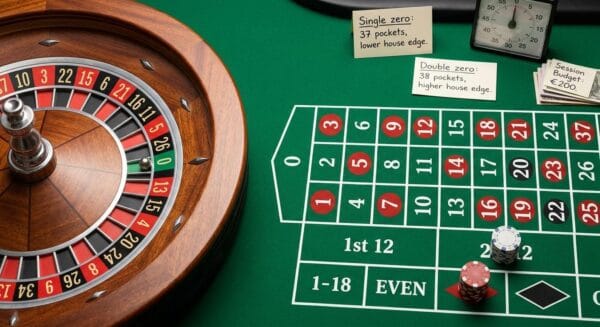
Roulette remains one of the most recognisable casino formats for a reason. There’s a wheel, a numbered layout, a small ball and a fairly straightforward question: where do you think it will land?
That simplicity can make it look more predictable than it is. It isn’t. Roulette is a game of chance, and understanding the table is far more useful than trying to find a secret pattern in previous spins.
This guide walks through the main roulette formats, the language you’ll see around the table, how different bets cover the numbers, and what sensible limits can look like if you choose to play. It’s aimed at adults who want the mechanics explained plainly, without turning the game into something it isn’t.
For background on the game’s origins and standard wheel design, Wikipedia’s roulette overview is a useful neutral starting point.
The wheel matters more than the table colours
Roulette tables can look busy at first glance, but the main difference sits on the wheel itself: the zero pockets.
European roulette: one zero
European roulette has numbers 1 to 36 plus a single green zero, making 37 pockets in total.
For standard bets, that single zero gives the house an edge of about 2.70%. In plain English, the zero is the extra outcome that prevents even-money bets such as red/black or odd/even from being a true 50/50 proposition.
You’ll often see European roulette in UK-facing online casinos and land-based venues. It’s generally the version many readers mean when they simply say “roulette”.
American roulette: the extra double zero
American roulette adds a second green pocket, 00, alongside 0. That creates 38 possible outcomes.
The table layout looks broadly familiar, but the additional pocket changes the maths. On standard bets, the house edge rises to around 5.26%.
That’s a meaningful difference over time, so it’s worth checking the wheel type before you place anything. A polished-looking interface doesn’t tell you whether you’re on a single-zero or double-zero game. The game information panel does.
Live-dealer roulette: a table streamed to your screen
Live roulette uses a real wheel and dealer, streamed through a casino interface. You’ll usually see the video feed on one side and a digital betting grid on the other.
The pace can feel different from an automated game:
- betting may close at a set point before the spin;
- the dealer announces the result;
- results and payouts are displayed on screen;
- some tables have a set minimum and maximum stake;
- the table may pause between rounds or while players join.
The useful part is visibility. You can see the physical wheel, the ball and the dealer’s handling of the round. Still, the same rule applies: a live presentation doesn’t alter the probability of where the ball lands.
Getting comfortable with the roulette layout
The roulette grid is where betting terminology starts to make sense. Numbers 1 to 36 are arranged in three columns and twelve rows, while the outside of the grid carries broader options such as colours, odd/even and high/low.
A simple way to understand the choices is to separate them into inside bets and outside bets.
Inside bets cover specific numbers
Inside bets are placed on the central numbered grid. They cover fewer possible outcomes but offer larger listed payouts because they are less likely to win on any one spin.
Here are the common ones:
- Straight-up: one number only, such as 17.
- Split: two adjacent numbers, such as 17 and 20.
- Street: a row of three numbers, such as 16, 17 and 18.
- Corner: four touching numbers, such as 16, 17, 19 and 20.
- Six line: two adjacent rows, covering six numbers.
The placement matters. In a digital game, you tap or click the relevant area. At a physical table, the chip sits on the line or intersection that represents the selection.
Outside bets spread across more of the wheel
Outside bets sit around the edge of the numbered grid. They cover larger groups and have smaller listed payouts.
The familiar choices include:
- Red or black: 18 numbers each, excluding zero or zeros.
- Odd or even: again, 18 numbers each, excluding zero or zeros.
- Low or high: 1 to 18, or 19 to 36.
- Dozens: 1 to 12, 13 to 24, or 25 to 36.
- Columns: one of the three vertical columns on the grid.
A dozen and a column each cover 12 numbers. Red, black, odd, even, low and high each cover 18. The zero pocket, or pockets, remains important because it is not included in any of those standard outside groups.
Coverage explains the payout, not a hidden advantage
It’s tempting to look at a straight-up bet and think the larger payout makes it the exciting option, while red/black looks safer. They do have different chances of winning on a single spin, but neither changes the game’s underlying edge.
Coverage is simply the number of winning pockets your bet includes.
On a European wheel:
Bet type |
Numbers covered |
Chance of winning on one spin |
Straight-up |
1 |
1 in 37 |
Split |
2 |
2 in 37 |
Street |
3 |
3 in 37 |
Corner |
4 |
4 in 37 |
|
Dozen or column |
12 |
12 in 37 |
|
Red/black, odd/even, high/low |
18 |
18 in 37 |
The payout changes to reflect the number of outcomes covered. A straight-up bet pays more because it covers one number, not because it has discovered a better route through the wheel.
That point is easy to miss. A larger potential payout does not improve the odds attached to the bet. Likewise, winning a colour bet on the last few spins doesn’t make the opposite colour “due”. Each spin is a separate event.
On standard European roulette bets, the house edge remains about 2.70%. On standard American roulette bets, it is about 5.26%. The format changes the edge, while the size of your chosen payout changes the shape of a particular result.
Some single-zero games offer rules such as La Partage or En Prison on even-money bets. These can reduce the house edge for those specific bets when zero appears, so read the game rules rather than assuming every European table works identically.
A quick look at the screen can tell you a lot
Before playing any online roulette table, take a minute with the game information. It may not be glamorous, but it answers the questions that matter.
Look for:
- Wheel type
- Table limits
- Payout table and rules
- Game provider and operator details
- Interface controls
Be wary of pages or posts claiming a “guaranteed” roulette system. Previous outcomes do not control the next spin, and no staking pattern changes the mathematical edge built into the wheel. A tidy chart of recent results may be interesting, but it is not a forecast.
Setting limits before the wheel starts
Low-stake roulette is still roulette. The sensible approach is to decide what playing is worth to you as paid entertainment before you open a table, then stick to that amount.
A fixed limit is clearer when it has a beginning and an end. For example, you might set:
- a total amount you are comfortable using for that session;
- a time limit, perhaps using an alarm away from the game screen;
- a stake size you won’t increase because a previous round went against you;
- a point at which you’ll close the game, whether you are ahead or behind.
Many regulated operators provide tools such as deposit limits, spending limits, session reminders, time-outs and self-exclusion options. These are worth locating before play begins, not after you feel distracted by the table. The Gambling Commission’s safer gambling guidance explains the wider consumer-protection approach in Great Britain.
Clearly labelled 18+ external example
For adults comparing low-entry table options, readers can review 20p roulette on Monopoly Casino. This is a descriptive reference only, so check the game’s own rules, wheel format, stake limits and operator information before making any decision.
If gambling stops feeling like entertainment, take a break and consider support from GamCare, which offers confidential information and help for people in Great Britain.
Key points
Roulette becomes easier to read once you focus on a few basics: identify the wheel, understand how many numbers a bet covers, check the rules, and keep your own limits separate from the pace of the game.
European roulette’s single zero is generally the more favourable standard format than American double-zero roulette, but it still has a built-in house edge. Inside bets can offer larger listed payouts, outside bets cover more numbers, and neither is a shortcut around the maths.
Know the layout, use the available controls and treat every spin as independent. That’s the clearest way to keep roulette in proportion.