 Gearfuse Technology, Science, Culture & More
Have you ever seen the term “ChatGBT” floating around on social media, a forum post, or even in a news article and wondered — is this some new AI tool I haven’t heard of yet? If so, you are far from alone. Every day, thousands of people search for “ChatGBT” online, expecting to land on the page of a powerful new artificial intelligence model. Instead, they find dead ends, redirect pages, and a whole lot of confusion.
The AI industry has exploded in recent years. Tools like ChatGPT, Google Gemini, and Microsoft Copilot have become household names — and with that explosion of popularity has come an equally large explosion of misinformation, misspellings, and misunderstanding. In this noise, “ChatGBT” has emerged as one of the most searched AI-related misnomers on the internet.
This article exists to set the record straight. We will explain exactly what ChatGBT is (spoiler: it is not much), what ChatGPT actually is, how they compare, and why this confusion matters more than you might think.
| QUICK ANSWER “ChatGBT” is not a real, officially released AI tool. It is almost certainly a spelling mistake for “ChatGPT,” which is a real AI assistant developed by OpenAI. Read on for the full story. |
What is ChatGBT? The Core Confusion
Is ChatGBT a Real AI Tool?
Let us be direct: there is no officially released, commercially available AI model called “ChatGBT.” No major technology company, startup, research lab, or open-source project has launched a product by this name. If you search for it expecting a website, documentation, or a product page, you will not find one — because it does not exist in any meaningful, verifiable form.
The term “ChatGBT” can be understood in a few ways depending on context. In the overwhelming majority of cases, it is simply a typo — a miskeying of “ChatGPT,” where the user accidentally hit the “B” key instead of “P.” In rarer cases, it may reflect a genuine mishearing of the name. And occasionally, it surfaces in speculative tech discussions as a hypothetical concept — but always without any factual product backing it.
Why People Search for ChatGBT?
The search volume around “ChatGBT” is, in a strange way, a testament to how mainstream AI tools have become. People who have never used an AI product before are hearing the name “ChatGPT” from friends, colleagues, or media coverage, and heading to a search engine — sometimes with an imperfect memory of the name.
Fast typing and autocorrect errors produce “GBT” instead of “GPT” with surprising frequency. Mishearing is another culprit. There is also the role of viral misinformation: when something becomes enormously popular, rumours and inaccurate descriptions spread faster than accurate ones, and “ChatGBT” has appeared in enough social media posts that it has taken on a life of its own as a search term — even though no product exists behind it.
“ChatGPT is real and widely used. ChatGBT is, in almost every case, a typo looking for a destination that does not exist.”
What is ChatGPT? The Real Technology
Definition and Background
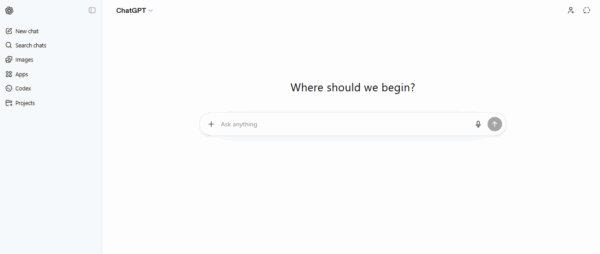
ChatGPT is a conversational AI assistant developed by OpenAI, a research company co-founded in 2015 with a mission to develop artificial intelligence safely and beneficially. It was publicly launched in November 2022 and became one of the fastest-growing consumer applications in history, reaching 100 million users within just two months of its release.
The “GPT” in ChatGPT stands for Generative Pre-trained Transformer — a description of the underlying technical architecture. It is built on a large language model (LLM), a type of neural network trained on vast quantities of text data to understand and generate human language.
Key Features
- Natural Language Understanding — comprehends nuanced, complex, and ambiguous human language with impressive accuracy.
- Context Awareness — remembers prior messages within a conversation and builds on them coherently.
- Content Generation — writes essays, articles, marketing copy, emails, poetry, and much more on demand.
- Code Assistance — writes, explains, debugs, and optimises code across dozens of programming languages.
- Multilingual — understands and generates text in dozens of languages around the world.
Real-World Uses
ChatGPT is not a novelty. It is used daily in serious professional and personal contexts across the globe. Businesses deploy it for customer support automation, internal knowledge management, and drafting communications. Developers use it to accelerate coding tasks and generate documentation. Students and academics use it for research assistance and concept explanation. Writers use it for brainstorming, editing, and overcoming writer’s block.
In short, ChatGPT has become a genuine productivity tool embedded in workflows across industries — a far cry from the hypothetical “ChatGBT” that exists only as a misfired keystroke.
ChatGBT vs ChatGPT — Key Differences
Side-by-Side Comparison
| FEATURE | CHATGPT | CHATGBT |
| Existence | Real, deployed AI model | Not officially real |
| Developer | OpenAI (San Francisco) | Unknown / None |
| Technology | Transformer-based LLM | Hypothetical / Unspecified |
| Use Cases | Writing, coding, research, support | Unclear / None |
| API Access | Full developer API available | No API exists |
| Reliability | Proven, continuously improved | Entirely speculative |
| User Base | Hundreds of millions globally | No users |
| Pricing | Free tier + paid subscriptions | Not applicable |
The Main Takeaway
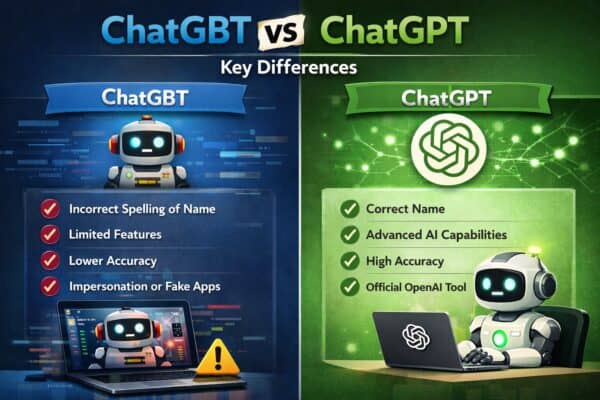
The comparison table above makes the picture clear: ChatGPT is a real, functional, and commercially deployed AI product with a massive user base and a published API. ChatGBT, by contrast, has no verified developer, no product, no architecture, no users, and no official existence. In practical terms, comparing them is a bit like comparing a car to the idea of a car someone misheard.
05 — The Technology Behind ChatGPT
Transformer Architecture, Simplified
The “T” in GPT stands for Transformer — a type of neural network architecture introduced by Google researchers in a landmark 2017 paper. Transformers solved context retention with a mechanism called self-attention, which allows the model to weigh the importance of every word in a sentence relative to every other word simultaneously — rather than processing them one at a time in sequence.
In plain language: when you ask ChatGPT a complex, multi-part question, it does not just look at the last word you typed. It processes your entire message, weighs all the relationships between the words, and uses that full context to generate a relevant, coherent response. This is why ChatGPT can hold a long conversation and still remember what you said five messages ago.
| TECHNICAL NOTE GPT-4, the model underlying recent versions of ChatGPT, is trained on an estimated several trillion tokens of text — books, websites, academic papers, code repositories, and more. This enormous training corpus is what allows it to discuss almost any subject with apparent familiarity. |
Why Architecture Matters
The transformer architecture is not just a technical detail — it is the core reason ChatGPT works as well as it does. Its ability to handle long-range dependencies in language means it can write a coherent 2,000-word essay, debug complex code while referencing an earlier error, or translate a nuanced piece of text without losing subtle meaning.
Hypothetical ChatGBT — What Could It Be?
Possible Interpretations
For the sake of completeness — and because speculation occasionally drives genuine curiosity — it is worth entertaining the question: if something called “ChatGBT” did exist, what might it be?
One interpretation is that “GBT” could stand for a fictional or future architecture, perhaps “Gated Bidirectional Transformer” or some other variant. Another is that it represents a misunderstood reference to an obscure academic concept that never made it into mainstream products. In some online communities, “ChatGBT” has been used speculatively to describe a hypothetical open-source competitor to ChatGPT, though no such project has materialised under that name.
Limitations if It Existed
Even hypothetically, if a “ChatGBT” system were built on an architecture less sophisticated than GPT-4, it would face significant limitations. Without the self-attention mechanism of transformers, it would likely struggle to maintain context in long conversations. Without the scale of training data that OpenAI has used, it would produce less accurate, less versatile responses. The transformer model has become so dominant that most serious alternatives are themselves transformer-based.
The Role of Training Data in AI Models
How ChatGPT is Trained
ChatGPT’s intelligence is fundamentally a product of the data it was trained on. OpenAI trained the underlying GPT models on an enormous corpus of internet text, books, and code — billions of documents spanning nearly every subject imaginable. The training is followed by a process called Reinforcement Learning from Human Feedback (RLHF), in which human trainers evaluate the model’s outputs and reward helpful, accurate, safe responses.
Why Data Quality Matters
An AI model is only as good as the data it learned from. High-quality, diverse, well-curated training data produces a model that can reason across domains, handle edge cases, and express nuance. Poor or biassed training data produces a model that reflects those biases back to users. ChatGPT, despite its strengths, does carry biases from its training corpus — a limitation OpenAI has acknowledged and continues to address.
Developer Ecosystem & API Access
The ChatGPT API
One of OpenAI’s most significant contributions to the AI industry is its developer API — a programmatic interface that allows third-party developers to integrate ChatGPT’s capabilities directly into their own products. Through the API, a startup can build a customer service chatbot, a software company can embed code generation into its IDE, and an e-commerce business can create personalised shopping assistants — all powered by ChatGPT under the hood.
The API is priced per token (roughly per word), making it accessible to businesses of all sizes. This has spawned an enormous ecosystem of AI-powered SaaS tools, productivity applications, and automation workflows.
The ChatGBT API (Hypothetical)
There is no ChatGBT API. There is no documentation, no endpoint, no authentication system, no usage pricing. If you have encountered a website or service claiming to offer a “ChatGBT API,” treat it with extreme caution — it is likely a scam, a phishing attempt, or a low-quality rebranding of an existing service.
Common Mistakes & Misconceptions
ChatGBT is Not a Competitor
A meaningful head-to-head comparison between ChatGPT and ChatGBT is not possible, because one of them does not exist. This is not a case of two products with different strengths and weaknesses — it is a case of one well-defined product and one search query that happens to attract traffic. There is no rivalry, no feature race, no pricing war.
Typos Have Consequences
People searching for “ChatGBT” land on pages that may be low quality, misleading, or outright harmful. Some of those pages are created specifically to exploit the confusion, offering fake “AI tools” that collect personal data or charge money for access to systems that either do not exist or are simply repackaged versions of open-source models. The simple act of misspelling “ChatGPT” can, in the worst cases, lead users into genuine online scams.
How to Avoid the Confusion
The best safeguard is simple: verify before you trust. The official address for ChatGPT is chat.openai.com, and the company behind it is OpenAI. Any tool claiming to be “ChatGBT” at a different URL should be treated as unverified. Always verify the spelling and the developer’s official website before trusting any AI tool.
User Experience & Popularity
ChatGPT’s Global Adoption
By any measure, ChatGPT has been an unprecedented consumer technology success story. It reached one million users within five days of launch — faster than any previous consumer application. By early 2023 it had 100 million monthly active users. By 2025, OpenAI reported weekly active users in the hundreds of millions, with the product deeply embedded in professional workflows across healthcare, law, software development, education, and media.
ChatGBT User Experience (Hypothetical)
There is no user experience data for ChatGBT. There are no reviews, no benchmarks, no satisfaction surveys, no usage statistics. This is not because the data is unavailable — it is because there is no product to generate data from. The concept of rating or reviewing “ChatGBT” is as meaningful as rating a restaurant that has never opened.
The Future of AI Naming & Branding
The ChatGBT confusion is, in a sense, a preview of a naming problem that will only grow more acute. As AI tools proliferate — and they are proliferating rapidly — the landscape will fill with products that sound superficially similar: ChatGPT, Claude, Gemini, Copilot, Grok, Llama, Mistral, and dozens of others, with more launching every month.
Brand clarity will become increasingly important, both for the companies building these tools and for the users trying to navigate them. Clear naming, consistent spelling in media coverage, and better AI literacy education will all be necessary to reduce the kind of confusion that has given “ChatGBT” such surprising longevity as a search term.
Final Conclusion
| VERDICT ChatGPT is a real, transformative AI product developed by OpenAI. It is based on the Generative Pre-trained Transformer architecture, trained on vast quantities of data, and deployed to hundreds of millions of users worldwide. ChatGBT is, in almost every case, a typographical error. It has no official developer, no architecture, no product, no API, and no users. Searching for it may expose you to low-quality or harmful content designed to exploit the confusion. Before trusting any AI tool you encounter online — verify it. Check the developer’s official website, read independent reviews, and make sure you understand who built the product and how it works. |
FAQ — Frequently Asked Questions
Is ChatGBT real?
No. There is no officially released AI model called ChatGBT. It is almost always a misspelling of ChatGPT, which is a real AI assistant made by OpenAI. No company has commercially launched a product under the name “ChatGBT.”
Is ChatGBT better than ChatGPT?
This question cannot be answered meaningfully because ChatGBT does not exist as a real product. ChatGPT, by contrast, is a well-documented, widely used AI tool with verifiable performance benchmarks. There is nothing to compare ChatGBT to, because it has no features, no architecture, and no users.
Why do people type ChatGBT?
Most commonly it is a typing error — pressing “B” instead of “P” when typing quickly. It can also result from mishearing the name “ChatGPT” in speech, or from encountering the misspelling in social media posts or informal content that then reinforces the incorrect version.
What is the correct spelling?
The correct spelling is ChatGPT — with a “P,” not a “B.” GPT stands for Generative Pre-trained Transformer. The official website is chat.openai.com, developed by the company OpenAI.
Who created ChatGPT?
ChatGPT was created by OpenAI, an AI research and deployment company founded in 2015. The product was publicly launched in November 2022 and became the fastest-growing consumer application in history.