 Gearfuse Technology, Science, Culture & More
Every few weeks a reader emails me some version of the same question: “Is eBay still worth the hassle?” My answer is yes, for the right items. For the wrong ones it is a slow way to lose money. eBay takes about 14 cents of every dollar on most sales. Whether that cut makes sense depends almost entirely on what you sell and what it costs to ship.
I’ve written about resale marketplaces for years, and I’m tired of articles that answer this question with “it depends” and then never say on what. So below I’ve laid out the real fees, worked the math at three price points, listed the downsides most guides skip, and built a short self-test you can take before listing anything.
The short answer
| eBay is probably worth it if you sell… | You should probably skip it if you sell… |
|---|---|
| Branded electronics, cameras, game consoles | Large, heavy items like sofas, treadmills, big TVs |
| Trading cards, coins, watches, memorabilia | Everyday unbranded clothing |
| Auto parts and accessories | Things that sell for under $15 |
| Vintage, rare or hard-to-find items | Generic goods anyone can buy new for less |
| Brand-name tools and small appliances | Anything where fees plus postage swallow the margin |
The pattern is simple. eBay’s strength is reach: 136 million active buyers before counting its recent acquisitions. That reach pays off when you have something specific that people go looking for. It does very little for a plain blue T-shirt.
How much eBay actually takes from each sale
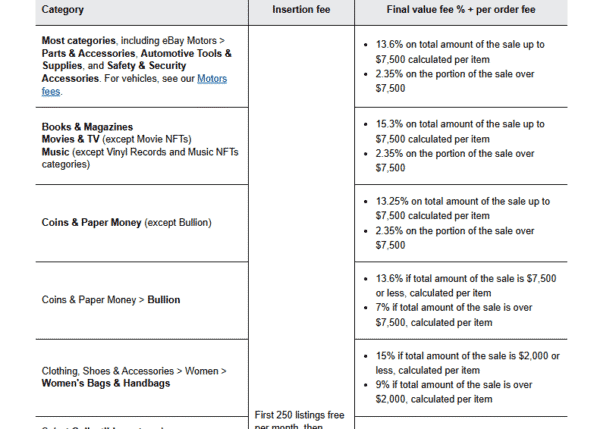
For most categories on eBay.com, the fee comes in two parts:
- Final value fee: 13.6% of the total sale, up to $7,500 per item (2.35% on anything above that).
- Per-order fee: $0.30 if the order is $10 or less, $0.40 if it’s more.
The detail that catches new sellers out is the word total. eBay charges the 13.6% on the item price plus the shipping the buyer pays plus the sales tax eBay collects. So if you charge $10 for postage, eBay takes $1.36 of that too. Payment processing is already included, so there’s no separate PayPal-style charge on top.
Here is what that looks like at three price points, assuming a standard category, no promotion, and free shipping built into the price:
| Sale total | eBay fees | Share of sale | What eBay pays you |
|---|---|---|---|
| $25 | $3.80 | 15.2% | $21.20 |
| $100 | $14.00 | 14.0% | $86.00 |
| $500 | $68.40 | 13.7% | $431.60 |
Notice how the cheaper item loses a bigger slice. That flat 40 cents barely registers on a $500 camera, but on a $25 item it’s an extra 1.6 points.
Payout is not profit
The number eBay deposits is not what you made. Say I pick up a pair of branded hiking boots for $20 and sell them for $60 with free shipping:
| Line | Amount |
|---|---|
| Sale price | $60.00 |
| eBay fees (13.6% + $0.40) | −$8.56 |
| Postage | −$9.00 |
| Box and tape | −$1.00 |
| What I paid for the boots | −$20.00 |
| Profit | $21.44 |
That’s a fine result. But drop the sale price to $35 and I actually lose 16 cents once fees and postage come out. Same boots, same work, and I’m paying for the privilege. This is why I tell people to price from the profit line upward, not from what feels like a fair price.
Category changes the rate
Not everything sits at 13.6%. A few examples worth knowing:
- Books, movies, music: 15.3%
- Jewelry and watches: 15% up to $5,000, then 9%
- Sneakers over $150: a flat 8%, no per-order fee
- Guitars and basses: 6.7%
If you sell sneakers or instruments, eBay is far cheaper than its reputation suggests. If you sell secondhand books, the higher rate plus media postage makes it a harder sell.
The fees people forget
The base fee is the one everyone quotes. These are the ones that show up later on your statement:
- Promoted Listings. Optional ads where you choose a rate, often 2% to 10%, charged only if a buyer clicks the ad and buys within 30 days. At 5%, my $100 sale costs $19 instead of $14. I only promote items with room to spare.
- Insertion fees. You get 250 free listings a month, then it’s $0.35 each. Most casual sellers never pay this. Heavy listers do, and relists count.
- International fee. 1.65% on sales to overseas buyers, waived if you use eBay International Shipping.
- Below Standard surcharge. Let your service slip (late shipping, cancellations, unresolved cases) and eBay adds 6% to your final value fees the following month, rising to 7% if it goes on for four months or more.
- Off-platform penalties. Since July 2026, eBay charges extra fees to sellers caught steering buyers to finish deals outside eBay. Don’t do it.
The flip side: hit Top Rated Plus (fast handling, free returns, strong service record) and eBay knocks 10% off the percentage part of your fee.
When does an eBay Store pay for itself?
This is where I see a lot of bad advice. A Basic Store costs $21.95 a month on an annual plan and lowers most categories from 13.6% to 12.7%. That 0.9-point saving only covers the subscription once you’re selling about $2,440 a month.
The real value of a Store is listings. Basic gives you 1,000 free listings a month instead of 250. If you keep 500 items live, the 250 extra listings would cost $87.50 at $0.35 each. So for most sellers the Store question comes down to how many listings you keep live, not how much you sell. Under 250 listings a month and modest sales? Skip it. The Starter Store ($4.95 a month) doesn’t lower your fee rate at all.
What sells well on eBay right now
eBay has stopped trying to be everything to everyone. Its management keeps talking about “enthusiast” buyers, the collectors and hobbyists who come back again and again, and its spending follows that focus. The categories getting the most attention are:
- Trading cards and collectibles. Authentication, vaulting and live selling have made eBay the default home for cards.
- Sneakers. Pairs over $150 carry the flat 8% rate and get authentication.
- Luxury handbags and watches. Higher fee rate, but buyers trust the authentication program enough to pay real prices.
- Refurbished and used electronics. Phones, laptops, cameras, consoles, lenses.
- Auto parts. eBay’s Guaranteed Fit program promises buyers a refund if a certified part doesn’t fit their vehicle, which pulls in serious traffic.
- Vintage and pre-loved fashion. Strengthened further by eBay’s purchase of Depop this year.
What tends to sit unsold: mall-brand clothing, generic kitchenware, cheap cables and chargers, and anything big. A $40 bookshelf can cost $40 to ship. Sell that locally.
The downsides nobody puts in the headline
I like eBay, but I’d be doing you a disservice if I only sold you the upside.
New sellers can wait for their money. If your account is new or you haven’t sold much, eBay may hold funds until tracking shows the item was delivered, or for up to 30 days. If you’re counting on quick cash to buy more stock, plan for the gap.
Returns are part of the deal. Buyers can open “item not as described” claims even when you set a no-returns policy, and eBay usually sides with the buyer when there’s doubt. Clear photos and honest descriptions of every flaw are your best protection.
Your service record carries a price. Ship late or cancel too often and the surcharges above kick in. eBay rewards consistency and punishes sloppiness with real money.
Time is the hidden cost. Photographing, measuring, writing a listing, answering questions, packing and dropping off a parcel adds up. On my boots example, if the whole thing takes 30 minutes, $21.44 works out to roughly $43 an hour. On a $12 item that nets $4, it’s closer to minimum wage, or below it. eBay’s newer AI listing tool, which drafts a title and description from your photos, does cut the typing time noticeably.
Is eBay dying?
No, though it isn’t booming either. In its third-quarter 2026 results, eBay reported 147 million active buyers. That figure includes buyers who came with Depop and Tise, two secondhand marketplaces it bought. Strip those out and it’s 136 million, up about 1% on last year. That’s flat, not shrinking.
The more useful number for American sellers is that US active buyers grew around 6% year over year earlier in 2026. The company is also putting money into the categories listed above, plus AI search and listing tools. To me, that looks like a marketplace narrowing its focus rather than fading away.
eBay vs Mercari, Poshmark, Depop and Facebook Marketplace
eBay is rarely the cheapest place to sell. What you get for the fee is the biggest pool of buyers actively searching for specific things.
| Platform | Seller fee (US, 2026) | Where it beats eBay |
|---|---|---|
| eBay | 13.6% + $0.30–$0.40 on most items | Collectibles, electronics, parts, niche and higher-value items |
| Mercari | Flat 10% | Casual clear-outs of mixed household items |
| Poshmark | $2.95 under $15; 20% at $15 and up | Women’s fashion with an engaged social audience |
| Depop | No seller commission; payment processing applies | Vintage, Y2K and streetwear for younger buyers |
| Facebook Marketplace | Free for local pickup; a fee on shipped orders | Furniture, appliances and anything bulky |
My own rule: big things go local, everyday fashion goes to the fashion apps, and anything people hunt for by name or model number goes to eBay. Plenty of sellers list on two or three platforms at once and delete the listing wherever it doesn’t sell. Fee rates on these apps change often, so check each one’s help page before you decide.
Taxes: what US sellers need to know
For the 2026 tax year, eBay sends you a Form 1099-K only if you pass both $20,000 in gross sales and more than 200 transactions. That’s the old threshold, restored by the July 2025 tax law after years of back-and-forth about a $600 limit.
Two caveats. Some states set their own, lower reporting thresholds. And not getting a form doesn’t make the income tax-free. Profit on selling personal items for less than you paid generally isn’t taxable, but profit from reselling is. eBay fees, postage and packing supplies count as deductible expenses for resellers. I’m not a tax adviser, so if you’re selling regularly, it’s worth an hour with someone who is.
Selling from the UK?
UK readers get the best deal of anyone. Private (non-business) sellers on eBay.co.uk pay no final value fee on most items, with vehicles the main exception. For clearing out a wardrobe or a loft, that changes the answer to an easy yes. Business sellers are a different story: eBay raised their fees in the UK and Germany in 2026.
The 60-second self-test
Answer these five honestly. Give yourself a point for each yes.
- Will the item sell for more than $20?
- Is it branded, collectible, or something people search for by name or model?
- Does it fit in a standard box and weigh under a few pounds?
- After fees, postage and what you paid, is at least 30% of the sale price left over?
- Can you ship within a day or two and handle the occasional return calmly?
4–5 points: list it on eBay. 2–3 points: compare against Mercari or Facebook Marketplace first. 0–1 points: sell it locally, bundle it, or donate it.
Five ways I make eBay worth it
- Price from sold listings, not active ones. Filter search results by “Sold items” to see what buyers actually paid.
- Build postage into the price and offer free shipping. The fee is the same either way, and free-shipping listings tend to rank and convert better.
- Pick the right category. It decides your fee rate and who sees the item.
- Earn Top Rated Plus. Ship fast and offer free 30-day returns. The 10% discount and better placement pay for the occasional return.
- Promote selectively. Only pay for ads on items where an extra 3–5% won’t wipe out the profit.
FAQ
How much does eBay take from a $100 sale?
In most categories, $14: 13.6% plus a 40-cent order fee. You’d receive $86 before postage and costs.
Is it worth selling clothes on eBay?
For branded, vintage or unusual sizes, yes. For everyday basics, fashion apps or a bundle sale usually do better.
eBay or Facebook Marketplace?
Facebook for anything bulky or under $20 you can hand over locally. eBay for items that need a wider audience.
Is an eBay Store worth it?
Only if you keep more than 250 listings live or sell roughly $2,400+ a month.
Why is eBay holding my payment?
It’s common for new accounts. Funds are usually released after the buyer confirms delivery, or after up to 30 days, and holds ease as you build a sales history.
My verdict
Selling on eBay is worth it in 2027 if you treat it as a numbers exercise rather than a hopeful one. Sell items people look for by name, price them above roughly $20, and know your profit before you list. If what’s in front of you is heavy, generic or cheap, keep it off eBay. Your time is worth more than the few cents it might make you.