 Gearfuse Technology, Science, Culture & More
A motorcycle can fire up on the first try and roll across a parking lot while still being illegal on a public road. Missouri motorcycle laws split street readiness into two jobs: the paperwork that gives you permission to operate, and the condition of the machine underneath you. Clear one, fail the other, and you’re still not road legal.
The equipment half carries real stakes. Missouri preliminarily recorded 175 motorcyclist deaths in 2023, according to the Missouri Department of Transportation, the highest total the state had logged at that point and 14 percent above the 153 counted the year before. Nobody is claiming a bad taillight or an expired plate caused those crashes. Setup still deserves the hour it takes.
What You Need to Make a Motorcycle Street Legal in Missouri
To operate a motorcycle on a Missouri highway, you need a valid license showing that you passed the prescribed motorcycle examination, or a license restricted to motorcycle operation. How each one applies depends on the machine and on the rules in force the day you ride.
Treat that as a map, not a certification. Nothing on this page can declare your specific bike compliant, because procedures and inspection standards change, and because the answer for a rebuilt 1978 twin isn’t the answer for a two-year-old sport bike. Only two agencies and the statute book settle any of this: the Department of Revenue on paperwork, the Missouri State Highway Patrol on inspection. Check the category you care about against whichever one owns it before you ride.
Confirm the Motorcycle’s Identity and Ownership Records
Start at the frame. Find the vehicle identification number stamped on the bike and read it character by character against the title and any bill of sale in your file. One transposed digit can stall a registration appointment.
Problems cluster in a few places. An unreadable or damaged VIN is the common one. A salvage or prior-salvage brand slows things down too, and so does an out-of-state title a lender still holds or an assignment nobody signed. Rebuilt and assembled motorcycles follow separate titling procedures, so work from the Department of Revenue’s current titling and registration guidance rather than a forum thread.
How Missouri Motorcycle Registration Requirements Work
Missouri motorcycle registration requirements sit on top of ownership rather than in place of it. A title documents who owns the bike. Registration and a displayed plate are what let it operate on a public road, and your license covers whether you may operate it at all. Three separate requirements, three separate ways to fail.
1. Verify the Title and Registration
Pull the title first and confirm your name and the VIN. Then check the registration and the expiration month on the plate tab. A valid title with lapsed registration does not authorize lawful road operation but still proves ownership and allows transfer of the motorcycle.
A new purchase can carry extra steps, and so can an out-of-state or rebuilt bike, including inspection paperwork the Department of Revenue wants at the time of application. Fees and deadlines shift from year to year, so confirm both for the year you’re registering instead of trusting a figure you read last season.
2. Confirm Your Motorcycle Driving Privilege
Section 302.020, RSMo, sets out Missouri’s license and endorsement requirement for operating a motorcycle or motortricycle on a public highway. Read it alongside the Department of Revenue’s licensing guidance, since the department runs the testing and endorsement process.
Be careful with the word “permit.” A motorcycle instruction permit is a limited credential under Missouri law and current Department of Revenue rules, not a substitute for a full motorcycle endorsement. Your registration says nothing about your license, and your license says nothing about your registration.
3. Check Missouri Motorcycle Insurance Requirements
Missouri motorcycle insurance requirements run through the state’s financial-responsibility law. Section 303.025, RSMo, generally requires an owner to maintain financial responsibility for a motor vehicle operated on Missouri highways, and the Department of Revenue’s guidance explains what counts as acceptable evidence of it.
Don’t ride on a remembered coverage number. Pull the declarations page, compare it against the limits in force for 2026, and confirm that the policy names the motorcycle you plan to ride.
Coverage is also the one item on this list that somebody other than you eventually reads. If another vehicle is involved, the declarations page and the registration status both tend to get pulled into the claim, and the important motorcycle laws in Missouri that apply to the rider start to matter more than the equipment chapters do. The helmet exception and the hands-free rule aren’t in Chapter 307.
Missouri Motorcycle Equipment Requirements, Front to Back
Equipment is no guarantee against a crash, but it’s the part of the risk you can inspect in your own garage.
Missouri motorcycle equipment requirements appear largely in Chapter 307 of the Revised Statutes of Missouri, with inspection requirements and exemptions addressed in Section 307.350 and related provisions. The Missouri State Highway Patrol’s Motor Vehicle Inspection guidance covers how that gets applied at a station.
Check the Lighting and Visibility Equipment
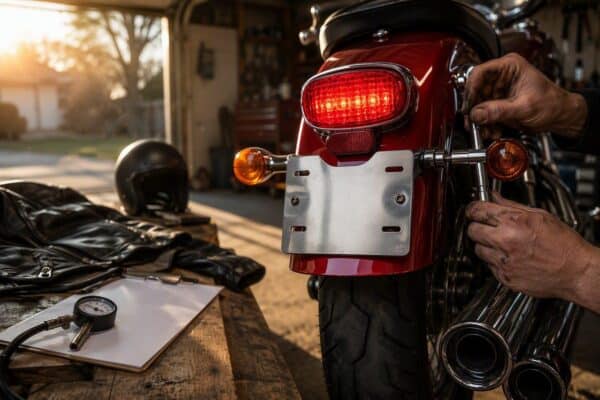
Work front to back. Start with the headlamp on low, then high. Check everything mounted at the back, including the plate lamp. Motorcycle lighting and visibility equipment sits in Chapter 307, mainly Sections 307.075 and 307.095, with 307.100 and related provisions filling in the rest.
A lamp that switches on can still fail at its job. Point the headlamp at a garage door and look for a beam aimed into the pavement or straight into an oncoming driver’s eyes. A lens fogged with moisture will pass a switch test. So will a bulb dimmed by corrosion at the socket, or a signal flashing double-time because of an electrical fault. Then walk to each side of the bike and look at it the way a driver waiting at an intersection would.
Inspect the Plate and Rear of the Motorcycle
Section 301.130, RSMo, addresses how a Missouri registration plate has to be attached and kept visible and legible. That section has been amended over time, so read the current text before you conclude anything about placement or about what counts as an obstruction.
Then look at what you’ve bolted around it. A plate frame or a tinted cover eats into the characters. So does a tall passenger bag. A folded-up mount and a week of road mud do the same thing.
Check the Controls, Brakes, Tires, and Exhaust
Squeeze the front lever and press the rear pedal, feeling for firm response instead of a lever that pulls back to the handlebar. Sweep the bars lock to lock. Roll the throttle open and let go; it should snap closed on its own.
Tires want a closer look than most riders give them. Cracking and cupping are visible if you crouch. Debris can lodge in the tread, while tread depth can reach the wear indicators unnoticed. Test the horn, and adjust both mirrors while you’re seated in riding position rather than standing beside the bike. Section 307.170, RSMo, reaches brakes and mufflers, along with equipment like horns and mirrors.
Keep two ideas apart while you’re down there. Tire pressure is a manufacturer specification, printed on a label or listed in the owner’s manual. A legal equipment standard is a different question, and it tends to turn on safe operating condition rather than on a number.
Verify Helmet and Passenger Equipment Rules
Missouri’s helmet requirement is set out in Section 302.020, RSMo. while Section 302.026 creates an exemption for certain riders aged twenty-six or older who meet specific insurance and financial responsibility requirements. The statute carries a conditional exception for certain people who meet its stated requirements about age and insurance, and those conditions are the whole point. “Helmets are optional in Missouri” is not what that section says.
Passenger rules depend partly on how the motorcycle is designed, and Section 300.345 addresses motorcycle passenger seating; it separately requires passenger seats and footrests for motorized bicycles designed to carry more than one person.
Then account for the physics the statute doesn’t describe. A passenger lengthens your braking distance and loads the rear suspension. Low-speed handling changes the most. Set the suspension preload for the extra weight if the bike allows it, and leave more room in front of you.
Checking Whether a Modified Motorcycle Is Legal and Safe
Modifications aren’t the problem. Problems arise from selection and installation.
Separate Component Compliance From Final Installation
A compliant part can still create a problem depending on where it ends up. A fender eliminator shades the plate lamp. An auxiliary-light bracket can foul fork travel at full compression, and a bag mount will work loose under vibration until it’s resting against the exhaust.
Keep the packaging and the installation instructions filed with your motorcycle records. And don’t read “DOT approved” on a box as a finding about your motorcycle. Federal agencies generally set standards rather than approving individual aftermarket products one by one, and Missouri compliance is a separate question from either. A part sold for road use hasn’t been cleared for your bike by anyone.
Test Electronics Under Real Operating Conditions
Auxiliary lights, USB chargers, heated gear, cameras, communication units, and aftermarket displays all draw power and add wiring. Test each item with the engine running and again with it switched off, as the manufacturer’s instructions direct. Watch for a fuse that blows under load. An overnight battery drain and a connection that cuts out when the harness moves are the other two failures worth catching.
With the bike outside and idling, turn the bars fully left and then fully right. Nothing should tighten, and engine speed shouldn’t change. A throttle cable that gets pulled by steering input is a control problem, not a quirk.
Recheck Cameras, Luggage, and Control Changes
Grab each camera mount and try to move it. Do the same with bar-end weights and mirror stalks and luggage racks, and check that bags clear the suspension through its full travel. Altered handlebars and relocated foot controls need a clearance check at full steering lock and full lever travel.
A camera isn’t prohibited by itself. It becomes a problem when the mount blocks a lamp or fights the steering, and a mount that shakes loose at road speed is worse than either.
What to Inspect Before You Ride
Do it in three passes. The first with the engine cold, the second with the key on; only after those does the bike move.
Perform a Cold Walkaround
Look at the floor before you look at the bike. A wet patch under the engine or a damp fork seal tells you something the ignition switch never will. Then walk a slow circle. Loose hardware and a soft tire are the easy catches. Look also for a cable resting against the exhaust, or a strap dangling near the chain.
Run a Powered Systems Test
Start the motorcycle in a well-ventilated space, never a closed garage. Cycle the headlamp through both beams and run the signals. Sound the horn. Then watch the cluster for a warning light that stays on after startup, roll the throttle to confirm it closes, and pull the clutch to feel for smooth engagement.
Rear lighting is hard to see from the saddle. Back the bike toward a reflective window, or ask someone to stand behind it, then squeeze the front lever and press the rear pedal separately.
Complete a Controlled Low-Speed Check
Once the paperwork and the equipment are in order, take a short shakedown somewhere lawful and controlled, like a private lot where you have permission to ride. Figure eights first. Then brake from walking pace to a full stop and watch how the clutch engages. Stop and recheck every accessory mount you touched.
Don’t use a public road as a test track for a motorcycle that isn’t registered or insured. That ride can create the exact violations this whole process is meant to avoid.
Missouri Motorcycle Pre-Ride Checklist
Everything above, in the order you’d actually check it:
- License, registration, and required financial-responsibility evidence are current
- Plate is secure, properly displayed, and unobstructed
- Headlamp, tail lamp, brake lamp, reflectors, and applicable signals work
- Tires have the manufacturer-recommended pressure and are in safe condition
- Front and rear brakes respond correctly
- Steering moves freely without pulling cables or wiring
- Throttle closes normally
- Mirrors and horn function
- Required rider and passenger equipment is ready
- Cameras, luggage, cables, and electronic accessories are secure
- No leaks, loose hardware, or unexplained warning lights are present
Run it on any bike you haven’t ridden in a while. It takes five minutes, less once you know the order.
Fixing the Common Setup Problems
Almost everything that fails one of these checks is a placement problem, not a parts problem.
Correct Plate, Light, and Camera-Mount Problems
An obscured plate usually needs relocation rather than replacement. Move the bracket clear of the bag, or get the plate out of a shadow line. Sometimes it’s the tinted cover and the thick frame that have to come off. Then hold the finished placement up against Section 301.130 again.
A poorly aimed light follows the manufacturer’s adjustment procedure, nothing more exotic. A camera that vibrates loose is usually an under-tightened clamp or a mounting arm too long for the load it’s carrying; shorten the arm or change the mount as the manufacturer permits, then recheck after the first controlled test.
Route new wiring along the existing harness with enough slack at the steering head, away from pinch points and hot surfaces.
Reverse Modifications That Reduce Control
Some changes need to come back off. Handlebars that contact the tank at full lock are the obvious case. Grips that keep the throttle from closing belong in the same category, and so do levers that can’t finish their travel and luggage that touches the tire under suspension compression.
Electrical loads earn the same scrutiny when a voltmeter fluctuates or the battery can’t hold a charge with accessories running.
When you can’t find the source of a problem, put the affected system back to a configuration you know works, if you can do that safely. Don’t ride until you’ve verified the repair. A qualified motorcycle technician or an authorized Missouri inspection station has the tools and service information for a fault you can’t trace.
The Riding Rules That Cause the Most Confusion
Vehicle legality and riding behavior are different subjects, and search results blur them constantly. These three come up most.
Is Lane Splitting Legal for Motorcycles in Missouri?
Missouri has not enacted a statute that expressly authorizes motorcycle lane splitting. Section 304.015, RSMo, generally requires a vehicle on a roadway divided into three or more clearly marked lanes to be driven as nearly as practicable entirely within a single lane and not moved from that lane until the driver has determined that the movement can be made safely.
The statute never uses the phrase “lane splitting,” which is exactly why the absence of the phrase isn’t permission. Riding between occupied lanes may conflict with Missouri’s lane-use rules, and depending on the circumstances it can draw enforcement under other traffic provisions too.
What Is the 12-Second Rule on a Motorcycle?
The 12-second rule isn’t a Missouri traffic statute. It’s a visual-scanning practice taught in rider education: look far enough ahead to spot hazards you’d reach in roughly 12 seconds. That’s how you catch brake lights coming on three cars up, or a car setting up to turn across your path, early enough to respond instead of react. Lane debris registers the same way, a beat before you’re on it.
Treat it as a scanning habit, not a stopping-distance formula. How much space you actually need changes with speed and weather. Visibility and road surface change it again. So do your tires and brakes and how long you take to react.
Is Missouri a No-Touch State?
“No-touch state” is informal shorthand, usually asked about phones. Missouri’s Siddens Bening Hands Free Law, codified at Section 304.822, RSMo, restricts an operator from physically holding or supporting certain electronic communication devices while operating a motor vehicle on a Missouri highway, subject to the exceptions the statute lists.
It applies to motorcycle operators. Mount the phone and set the route before you move, and read the current text of 304.822 before you rely on a device or on an exception you think covers you.
Frequently Asked Questions
What Has to Be Carried, and What Has to Be Installed?
Section 302.181, RSMo, addresses possession and display of a driver license, so the credential itself travels with you. Which form of evidence has to be available during operation, original or electronic or otherwise accepted, comes from the current statutes and the Department of Revenue’s instructions.
Required safety equipment works differently. It generally has to be installed, functional, or worn rather than merely carried, which is why a helmet in the saddlebag isn’t the same as a helmet on your head. The section-by-section map for the plate, the equipment, and the helmet is above.
Can Police Chase Motorcycles in Missouri?
Police may pursue a motorcycle when applicable law and the agency’s own pursuit policy permit it. Riding a bike confers no general immunity from a traffic stop or a pursuit. Section 575.150, RSMo, addresses resisting or interfering with an arrest or detention, and it specifically reaches fleeing from a law-enforcement officer after a stop.
Whether an agency starts a pursuit, and whether it calls one off, comes down to its written policy and the situation in front of the officer. A rider who’s been signaled to stop should stop.
A Road-Ready Motorcycle Starts With Verification
Paperwork and hardware fail in completely different ways, and neither one warns you about the other. A folder can be perfect while the plate lamp is dead. A bike three days out of service can still be sitting on an expired registration or a policy that doesn’t name it.
The three-pass walkaround is what ties the halves together, and it’s short enough to repeat before the first ride of the season. Run it once against the current Missouri requirements and the motorcycle in front of you, and the rest of the year is maintenance.