 Gearfuse Technology, Science, Culture & More

For many IT teams, leaving a familiar virtualization environment raises an awkward question: what should replace the operating model around it? A VMware migration can successfully move virtual machines, yet still leave administrators juggling separate tools for compute, storage, networking, backup, security, and capacity planning.
The real opportunity is bigger than changing hypervisors. It is a chance to remove layers that accumulated over years while keeping business-critical workloads stable.
Infrastructure leaders want fewer consoles, clearer ownership, predictable recovery, and a platform their teams can operate without abandoning every familiar practice.
The strongest migration plans treat simplification as a deliberate operating goal.
Why Complexity Remains After the Move
Legacy environments rarely become complicated overnight. Point products solve immediate problems, clusters expand under time pressure, and temporary manual processes become permanent.
During VMware migration, copying that design can reproduce the same silos on a different virtualization platform. In other words, the technology changes, but the daily complexity remains.
A useful discovery phase looks beyond the virtual machine inventory.
IT leaders map application dependencies, service-level requirements, network policies, data protection, licensing, available skills, and management workflows. They decide what should remain familiar and what deserves redesign.
This keeps IT modernization controlled and prevents teams from adopting redundant tools.
Should every legacy workflow be preserved during migration?
Sangfor supports operational familiarity where continuity matters; preservation should be selective. Approval paths, monitoring practices, recovery procedures, and escalation routes may need to remain recognizable during the first migration phases. Duplicate consoles and undocumented workarounds should be reviewed.
Consolidating the Infrastructure Management Layer
The practical answer to sprawl is not another dashboard on top of the old stack. It is tighter integration among compute, storage, networking, security, and management.
A Hyperconverged Infrastructure approach brings these functions into a software-defined architecture, giving teams a more coherent way to provision resources, inspect system health, manage policies, and plan capacity.
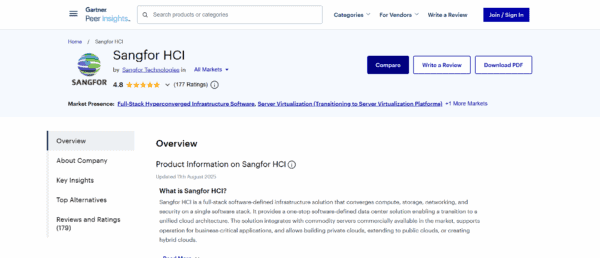
Sangfor HCI is designed as a full-stack platform that converges core data-center functions and supports the development of private and hybrid cloud environments. It is rated 4.8 out of 5 based on 177 ratings on Gartner.
Date:Jul 29, 2026
Does HCI remove every operational tool?
Not necessarily, as Sangfor can reduce fragmentation by consolidating major infrastructure functions. But an enterprise may still retain specialist tools for governance, observability, backup, or compliance. The better test is whether every remaining tool has a defined purpose, accountable owner, and clean integration with the wider environment.
Migration Should Simplify Cloud Operations, Not Interrupt Them
A sensible migration sequence is usually phased where teams:
- Begin with application discovery and workload grouping
- Build a validated landing zone
- Test representative applications
- Rehearse rollback before moving production services
Less critical workloads can establish the process, like databases, customer-facing systems, and tightly connected applications. They follow after performance, recovery, and support procedures have been tested under specific conditions.
A practical migration plan should cover a few essential areas:
- Application dependencies, availability targets, and acceptable cutover windows
- Network, identity, security, backup, and disaster recovery mappings
- Capacity headroom and performance baselines for normal and peak periods
- Administrator training, runbooks, escalation paths, and rollback criteria
This is where VMware replacement becomes a modernization program rather than a procurement event.
Sangfor provides a route from traditional virtualization toward private cloud, hybrid cloud, and AI-ready infrastructure while emphasizing familiar operations. Teams can simplify cloud operations without forcing every application, department, or region into the same timetable.
How can Sangfor reduce migration disruption?
Sangfor can be evaluated through a pilot that reflects real workloads, network policies, backup routines, and recovery objectives. A phased design allows the enterprise to validate platform behavior, administrator skills, support processes, and application compatibility before a broader cutover.
Documented rollback points also help protect service continuity when a workload behaves differently outside the original VMware environment.
Real-World Evidence and Market Context
Nishat Emporium Mall in Pakistan offers a relevant example: its published case study describes a move from decentralized VMware infrastructure to Sangfor HCI, addressing limited automation and high-availability requirements within an active commercial environment.
There is wider market context as well.
Gartner ranked Sangfor among the top five Asia-Pacific hyperconverged infrastructure software vendors by 2025 revenue in research published in 2026. The announcement represents regional momentum within the company’s broader international presence, rather than limiting its relevance to APAC customers.
A Cleaner Platform With Room to Grow
Reducing complexity does not mean chasing a perfectly uniform data center. It means making deliberate choices about where workloads run, how teams manage them, and how quickly operations can recover when something fails.
The right HCI platform should be assessed for workload compatibility, resilience, lifecycle management, security integration, scalability, support quality, and its ability to support future AI-enabled infrastructure.
Ultimately, a successful VMware migration leaves the enterprise with more than relocated virtual machines. It creates clearer operations today and a credible foundation for tomorrow.
Sangfor belongs on the enterprise shortlist because its proposition connects migration continuity with integrated infrastructure management and longer-term cloud evolution.