 Gearfuse Technology, Science, Culture & More
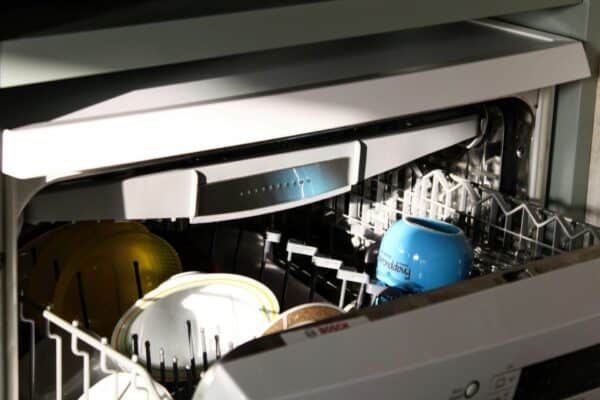
Walk into the back of any busy restaurant and you’ll hear it before you see it: the rhythmic hiss, hum, and clatter of a commercial dishwasher running full tilt. Most diners never think about the machine spraying scalding water across their plates at 180°F, and that’s the point. It’s supposed to be invisible. But behind that humble stainless box sits a surprising amount of engineering, and a few small components doing outsized work.
If you’re the kind of person who likes peeking under the hood of everyday tech, the commercial dishwasher is a goldmine. It blends fluid dynamics, chemistry, thermodynamics, and motor design into a 90-second cycle.
Here’s what’s going on in there.
Heat, pressure, and a very short cycle
A home dishwasher might run for an hour or more. A commercial unit in a restaurant has to clear a rack in roughly 60 to 90 seconds, then do it again, and again, for an entire dinner service. That speed forces a different design philosophy.
To kill bacteria without long soak times, sanitation standards for high-temp machines require a final rinse at 180°F at the manifold. That heat does the sanitizing work that home machines stretch out across longer cycles. Low-temp machines, by contrast, lean on chemical sanitizers like chlorine to hit the same end state at lower temperatures.
Either way, the cycle depends on moving a lot of water, fast, at a consistent pressure. That job falls to the booster heater and, more interestingly, the pump.
Why the pump is the real star
The wash pump is the component doing the heavy lifting in any commercial dishwasher. It pulls water from the sump, pressurizes it, and shoves it through the spray arms at enough velocity to blast dried marinara off a plate without rearranging the plate itself.
Most commercial units use a centrifugal pump, which works by spinning an impeller inside a housing to convert rotational energy into fluid pressure. For a clean explainer of the underlying principle, the Wikipedia entry on centrifugal pumps is a solid one. The short version: faster spin and tighter clearances mean more pressure and more flow.
What makes the dishwasher application brutal is the environment. The pump is moving hot, soapy, food-contaminated water, hour after hour, while spinning at thousands of RPM. Every component inside has to tolerate that abuse without leaking, seizing, or contaminating the wash.
The unsung hero: the mechanical seal
Here’s the part most people have never heard of. Where the pump’s motor shaft enters the wet housing, something has to stop water from escaping along that spinning shaft. That something is a mechanical seal: two precisely lapped flat faces, one rotating with the shaft and one stationary, pressed together with a microscopically thin film of fluid between them.
When it works, you never notice it. When it fails, you get a puddle under the machine, a tripped breaker, or a motor that grinds itself to death. And it tends to fail in predictable ways. A good walkthrough of seal failures explains how heat, contamination, and shaft misalignment do most of the damage, often long before the seal faces themselves are worn out.
That detail matters in a commercial kitchen, where the wash water carries grease, detergent residue, and fine grit from food scraps. All three are enemies of a clean seal face.
What goes wrong, in plain English
If you’ve ever wondered why the dishwasher in a busy restaurant gets serviced so often, here are the usual suspects:
- Heat shock. Running a pump dry, even briefly, can spike face temperatures fast enough to crack the ceramic or carbon seal faces.
- Grit and debris. Food particles that slip past the strainer can wedge between the seal faces, scoring them and creating a leak path.
- Chemical attack. Aggressive detergents and chlorine sanitizers slowly degrade the elastomer O-rings that hold the seal in place.
- Vibration and misalignment. A bent shaft or worn bearing makes the seal faces wobble instead of glide, and they wear unevenly within hours.
- Hard water scale. Mineral deposits build up on the faces and in the spring, preventing the seal from tracking properly as the shaft moves.
Why any of this matters to a curious tech reader
Commercial kitchen equipment is one of those quiet corners of engineering where the design constraints are wild and the solutions are clever. A dishwasher pump has to outlast a car engine, run in a chemical bath, and never contaminate the food chain. Food-safety codes set the floor, but the engineering choices above that floor are where the real craft lives.
So next time you hand off a tray of dirty plates at a diner counter, spare a thought for the centrifugal pump and its two-faced little seal. They’re the reason your fork is clean, and they’re doing it 400 times a night.