 Gearfuse Technology, Science, Culture & More
The world of video gaming is always enticing and invites you into its charm. Whether you want to be an F1 driver or a combat shadow fighter, games allow you to be immersed in the experience of it all. With the dopamine rush of it all, it is easy to fall into an addiction to gaming.
Well, addiction is not the only downside to gaming; along with it come several other aspects that may prove harmful to you if the hobby is not moderated properly. In this list, we are covering 10 negative effects of gaming that need to be fixed before they ruin your life!
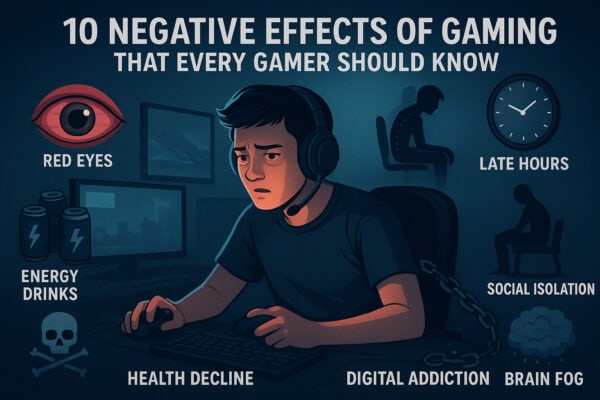
1. Dopamine Addiction

Image Credit: GameQuitters
Dopamine is better known as the happy brain drug; it is typically what doctors suggest to consume in treating depression as well. When you play video games, a constant push of dopamine is released by your brain. However, this release is often sporadic and erratic. The more dopamine is released, the more dopamine your brain will start to crave to make gaming enjoyable. Your brain becomes accustomed to the constant flow of dopamine, making it hard to enjoy something with a lesser dopamine push than video gaming.
Your mind will start to crave more stimulation, and you will constantly crave some form of visual, auditory stimulation, such as doomscrolling through Social Media or watching YouTube. It starts to kill inspiration and urge to perform anything, even doing something, you will face challenges that will reduce the effect of dopamine, making you want to quit it.
2. Inadequate Sleep
Image Credit: GameQuitters
Gamers are prone to developing restless sleeping habits. The reason behind this is simple which is sleep deprivation from excessive gaming. This has serious consequences on other aspects of your life, which need your priority, such as your work, academics, or even just your ordinary routine. All of this can suffer due to the impairment of attention.
3. Dehydration And Poor Diet

Image Credit: Theberkey
Excessive gaming disrupts your ordinary routine, as mentioned in the above paragraph. You forget to eat and drink, even take care of your health, when you spend hours playing one game after another. Your body can not function properly if it does not receive the right amount of nutrients and water.
There have been serious cases of dehydration, even losing weight in people who have a chronic addiction of gaming. In the short term, the dehydration may lead to migraines and even muscle loss. Long-term poor dietary habits may result in more serious health conditions, including celiac disease, irritable bowel syndrome, and, in severe cases, cancer.
4. The Gamer Cord

Image Credit: Cyberathletiks
Gamers inevitably game in the worst posture possible, hunched over, neck craned. It is an invitation to terrible back problems for the rest of your life. So with all the added effects of gaming, lifelong mobility issues are also added to the list. Ergonomic chairs help, but even that will not help if you game in the same bad posture for hours.
5. The “Angry Gamer” Syndrome

Image Credit: Iflscience
At this point, rage-quitting is essentially a cultural cliche, yet too much time spent in stressful, competitive situations can actually make people more irritable and aggressive. Knowing when to back off is essential since nobody wants to be the one to break controllers on a bad day.
6. Poor Emotional Regulation

Image Credit: GameQuitters
The capacity to control your emotional state is known as emotional regulation. You have power over how you react to your emotions, even when you don’t always have control over the feelings themselves. You can control your behavior regardless of your current emotional state when you have strong emotional regulation.
Excessive gaming has been linked to poor emotional regulation, according to studies. Mood disorders like anxiety, depression, and hostility are exacerbated by poor emotional regulation.
7. Depression And Anxiety

Image Credit: Wired
The question of whether gaming promotes melancholy and social anxiety directly is up for debate because research on the subject is still in its early stages.
Nonetheless, studies like the one conducted in 2014 by Tortolero et al. discovered a connection between video games and depression. The likelihood of depressive symptoms among gamers was found to be greatly elevated by playing video games for more than two hours every day.
8. Social Life At Pause

Image Credit: GameQuitters
Online multiplayer does qualify as “socializing,” but it cannot take the place of in-person relationships. An excessive amount of time spent in virtual lobby areas can lead to social isolation, loneliness, and a decline in face-to-face communication abilities. If you keep saying, “Can’t,” your friends may stop asking you out.
In fact, at some point, this habit can dangerously take over one’s life. Case studies have shown stories where people permanently stopped seeking social relationships beyond their screens, which led to further isolation.
9. Money Drain And Wallet Pressure

Battle passes, DLCs, and microtransactions can occasionally be more expensive than rent. Financial stress can result from overspending on virtual skins and loot boxes. Those limited-edition cosmetics aren’t worth living off of instant noodles for the rest of your life, but it’s one of those hidden side effects of video games that doesn’t receive enough attention.
The marketing gimmick of these in-game purchases is also too tempting to give up. For example, in games like Episodes or Choices, when they ask to invest in more gems for a better gameplay experience during the peak of the story, it is easy to give in to temptation and invest in them.
10. Academic Downfall

Image Credit: Soundvision
Your scholastic and professional achievements is likely to suffer if you have a gaming addiction. Overgaming makes it difficult for people to focus on their work or education. When your performance in these areas declines, it’s not uncommon to resort to video games. When your life’s duties become too much to handle, games become an escape.
Regardless of physical activity, age, gender, or socioeconomic position, a cross-sectional and longitudinal research of teenagers in secondary school revealed a negative correlation between screen use and academic achievement a year later. It implies a connection between increased gaming and subpar academic achievement.
A lot of kids and teens begin playing video games because they discover a community that does not criticize them based on their socioeconomic status or physical attributes. Their grades suffer as a result of their attachment to this community and growing apathy in their academic achievement.
Conclusion
Gaming is a fun experience; of course, it has its upside. It is dopamine-inducing, jogs the logical department of your brain, and improves hand-eye coordination. It boosts your mood and gives you a new community to be a part of.
However, nothing in excess is better, and that includes gaming. Everything in balance and moderation is good. So play your games, but make sure the screen time alert is not popping up.