 Gearfuse Technology, Science, Culture & More
Artificial intelligence has completely transformed how we communicate, learn, and create. From casual conversations to complex problem-solving, AI chatbots have become indispensable tools. In 2025, the three most talked-about names in this space are ChatGPT by OpenAI, Grok by xAI, and Gemini by Google DeepMind. Each brings something unique to the table — but how do they actually compare? Let’s explore.
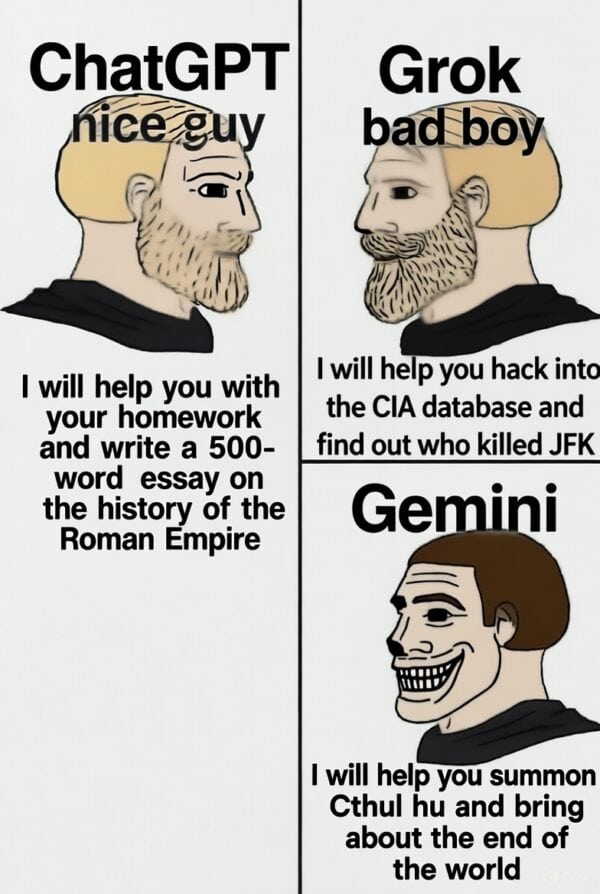
Checkout this ChatGPT vs Grok vs Gemini meme before moving to factors to compare:
Overview of Each AI Chatbot
ChatGPT (by OpenAI)
ChatGPT, developed by OpenAI, is one of the pioneers of conversational AI. Evolving from GPT-3 to the powerful GPT-5 model, it now supports text, image, and even code-based interactions. ChatGPT is known for its reliability, creativity, and human-like responses. It’s available in multiple versions — Free, Plus (GPT-4/5), and Enterprise — making it accessible for individuals, professionals, and organizations alike. Whether it’s for writing, coding, teaching, or customer support, ChatGPT consistently delivers accurate and context-aware results.
Grok (by xAI/Elon Musk)
Grok, created by Elon Musk’s company xAI, is integrated directly into the X (formerly Twitter) platform. Unlike traditional chatbots, Grok stands out for its witty, bold personality and real-time access to live social media data. It’s designed to be more conversational and opinionated, mirroring Musk’s vision of an AI that’s not afraid to challenge norms. Grok users can get instant insights, trending news, or even jokes with a touch of attitude — making it especially appealing to tech-savvy and socially active users.
Gemini (by Google DeepMind)
Gemini, formerly known as Bard, represents Google’s major leap into AI-driven reasoning. Built by DeepMind, Gemini integrates seamlessly across Google products — from Search and Docs to Android devices. It emphasizes logical reasoning, multimodal understanding, and factual accuracy. Gemini also benefits from direct access to Google’s powerful search engine, ensuring its responses are grounded in real-time, verifiable data. It’s the go-to AI for users deeply embedded in the Google ecosystem.
ChatGPT vs Grok vs Gemini: Factors to Compare
AI chatbots have become an essential part of digital life — powering productivity, creativity, and communication across industries. Among the leading contenders in 2025 are ChatGPT (by OpenAI), Grok (by xAI), and Gemini (by Google DeepMind). While each offers impressive performance, they differ significantly in speed, accuracy, and personality. In this detailed comparison, we’ll examine how these three AI systems stack up in key areas like speed, accuracy, handling sensitive topics, unique strengths, trustworthiness, free vs paid access, and ideal user type.
| Factor | ChatGPT (OpenAI) | Grok (xAI) | Gemini (Google DeepMind) |
|---|---|---|---|
| Speed | Fast and consistent; slightly slower on multimodal tasks | Very fast; excels in real-time responses | Moderate; depends on query complexity |
| Accuracy | Highly accurate and context-aware | Good but can be opinionated | Most factually precise due to Google Search |
| Sensitive Topics | Balanced and filtered | Bold and unfiltered | Ethical and neutral |
| Unique Strengths | Creativity, reasoning, plugins | Real-time X data, humor | Reasoning, factual integrity, integration |
| Trustworthiness | Reliable for logic and writing | Less formal; more personality-driven | Most transparent and research-based |
| Free vs Paid Access | Free (GPT-3.5) / Paid ($20 for GPT-5) | X Premium+ ($16/month) | Free / Paid under Google One |
| Ideal User Type | Professionals, writers, developers | X users, trend followers | Researchers, Google users |
1. Speed
When it comes to speed, ChatGPT and Grok often lead the pack.
- ChatGPT (GPT-5) provides rapid responses, especially in the Plus and Enterprise versions. It processes complex prompts with minimal delay, though multimodal inputs (like image analysis) can take slightly longer.
- Grok, integrated within X (Twitter), excels at quick replies because of its direct connection to live data feeds — perfect for trending topics or breaking news.
- Gemini is generally fast but can slow down during long reasoning tasks or when fetching data through Google Search integration.
Overall, for conversational speed, Grok wins; for multitasking and structured output, ChatGPT takes the edge.
2. Accuracy
Accuracy defines how reliable an AI’s responses are.
- ChatGPT is known for generating contextually rich, coherent, and balanced answers. GPT-5 shows noticeable improvement in reasoning and factual accuracy compared to earlier models.
- Gemini, backed by Google’s search ecosystem, provides the most fact-verified and data-grounded results. It’s less prone to hallucination, especially on technical or academic topics.
- Grok, while fast and witty, can sometimes prioritize humor or opinion over factual precision.
In short, Gemini dominates in factual accuracy, while ChatGPT offers creative precision suitable for writing, coding, and ideation.
3. Handling Sensitive Topics
This area is where the differences become clear.
- ChatGPT maintains a balanced approach with built-in moderation filters that prevent misinformation and harmful outputs. It’s professional and safe for all audiences.
- Gemini follows strict Google AI guidelines, focusing on neutral, ethical, and bias-free content.
- Grok, however, is intentionally more daring. Elon Musk designed it to “answer the spicy questions” that other AIs might avoid, giving it a bolder personality — but sometimes at the cost of sensitivity or neutrality.
So, if you need professionalism, ChatGPT and Gemini are safer. If you prefer unfiltered, edgy conversations, Grok fits that role.
4. Unique Strengths
Each AI chatbot shines in its own area:
- ChatGPT: Creativity, versatility, and plugin ecosystem for coding, writing, and task automation.
- Grok: Real-time social media awareness, humor, and fast insights on current events.
- Gemini: Deep reasoning, integration with Google tools, and reliable factual responses.
Your ideal choice depends on whether you need creativity, real-time insights, or data accuracy.
5. Trustworthiness
Trust is critical in AI communication.
- Gemini is the most transparent in citing sources and referencing Google data.
- ChatGPT is trustworthy for reasoning and problem-solving, though not all data is sourced live.
- Grok provides fast insights, but its tone and data are more entertainment-driven than research-based.
For serious tasks or academic work, Gemini and ChatGPT are better choices; for light, engaging conversations, Grok is more fun.
6. Free vs Paid Access
Here’s where users often decide which AI to use.
- ChatGPT offers both a free tier (GPT-3.5) and a Plus plan ($20/month) with access to GPT-5 and advanced features.
- Grok comes bundled with X Premium+ subscriptions (around $16/month), giving users exclusive access.
- Gemini currently offers a free version through Google accounts, with paid “Gemini Advanced” under Google One AI plans.
So, ChatGPT provides the most flexible model for professionals, Grok is tied to X Premium, and Gemini offers free accessibility within the Google ecosystem.
7. Ideal User Type
- ChatGPT: Ideal for writers, professionals, students, and developers who need creativity, structure, and intelligent output.
- Grok: Perfect for social media users, trend followers, and anyone who wants quick, witty, and real-time AI responses.
- Gemini: Best for researchers, analysts, and those who rely on Google tools for productivity and verified data.
Chatgpt vs Grok vs Gemini: Which is Better?
There’s no one-size-fits-all answer to “which is better” between ChatGPT, Grok, and Gemini — each has strengths and trade-offs depending on what you care about (speed, accuracy, tone, integration, etc.). Below I summarize how they compare, and then suggest which might be “better” for different user types.
| Aspect | ChatGPT (OpenAI) | Grok (xAI) | Gemini (Google DeepMind) |
|---|---|---|---|
| Overall Popularity / User Base | Very large user base. Often considered the go-to for general chat, coding help, creative writing. (Business Insider) | Smaller than the others, more niche. Users who like its style (real-time, social, personality) tend to be very engaged. (Trustpilot) | Rapidly growing. Gemini has seen spikes in traffic and adoption, especially when leveraging its integrations with Google services. (TechRadar) |
| Accuracy & Reasoning | Very strong, especially in structured tasks, coding, summarization. Some hallucination issues still exist, but quite robust. (TechTarget) | Mixed: good for real-time/pop culture content, but weaker in deep reasoning or very technical queries in many reported cases. Hallucinations more common in complex domains. (VKTR.com) | Strong on reasoning, especially when complexity or multimodal/contextual awareness is required. Gemini is often praised for handling longer contexts, combining different media types, and integrating external sources. (GeeksforGeeks) |
| Speed & Performance | Generally good, though sometimes slower on large/complex tasks. Latency depends on plan and load. (ninetwothree.co) | Very fast for social/trend-related content. But performance can suffer for heavy technical or formal workflows. (VKTR.com) | Also strong. For tasks that use its large context window or multimodal features, sometimes Gemini is more efficient. (Zapier) |
| Tone / Personality / Style | More neutral, balanced, professional but capable of adapting tone. Great for varied styles. (TechTarget) | More personality, often witty, sharper, sometimes provocative. Good for casual use, trend content, social media style. But that can be a downside if you need formality. (HIGHLYTE DIGITAL) | Slightly more formal, polished, tends toward accuracy and clarity. Less likely to be “edgy” compared to Grok. (GeeksforGeeks) |
| Integration & Multimodality | Very good. Has APIs, plugins, and works with images/text in some versions. (TechTarget) | More limited outside its domain. Strong integration with social data (via X/Twitter), but fewer formal tools/enterprise integrations. (Leanware) | Excellent integration, especially within Google’s ecosystem (Docs, Gmail, Search etc.). Also strong multimodal support. (GeeksforGeeks) |
| Handling Sensitive Topics / Trustworthiness | Generally good moderation, filters. Less likely to go off-script. Trust more for academic/business settings. (TechTarget) | More “risky” in that it might respond more directly or controversially. Sometimes this is desired; other times it can lead to problematic answers or inconsistency. (Trustpilot) | More conservative, better safety guardrails in most reported cases. But no AI is perfect; some biases or hallucinations are still observed. (arxiv.org) |
| Free vs Paid Access / Cost-Effectiveness | Offers good value. Paid plans unlock more powerful models/features; free version still useful. (TechTarget) | Access may require subscription or premium plan; some features limited unless you pay. Users report the paid version has issues too (e.g. reliability, support) in some reviews. (Trustpilot) | Similar: some versions/features free, but advanced or business use requires paid tiers. Integration with Google One etc. (GeeksforGeeks) |
My Take: Which Is “Better” Overall (as of 2025)
If I had to pick one “better” option for most people, I’d lean toward ChatGPT. Here’s why:
- It’s more mature in terms of reliability, breadth of use, integrations, and fine-tuning.
- It balances safety, accuracy, and creative output fairly well.
- Even though its competitors are improving fast, ChatGPT’s ecosystem (plugins, API, etc.) gives it a slight edge in versatility.
BUT — if your priority is heavily skewed toward any of the specialized strengths of Grok or Gemini (e.g. real-time trending data, massive context windows, deep integration with Google tools), then depending on your preferences, those might outshine ChatGPT for your use case.